

Electrophoretic coating (E-coating), also known as ED coating or electrophoretic deposition, is one of the most widely specified surface treatment technologies for metal components requiring exceptional corrosion protection and high salt spray resistance. By using an electric field to deposit a uniform coating layer, E-coating provides excellent coverage, strong adhesion, and reliable protection even on complex geometries with recessed areas and hard-to-reach surfaces.
This guide helps global buyers evaluate electrophoretic coating manufacturers based on the key factors that determine high salt spray performance—including coating technology, corrosion resistance, substrate compatibility, quality control systems, production capability, and supplier reliability. It also explains how Yongxin’s electrophoretic coating solutions compare across these critical decision factors.
Why Salt‑Spray Resistance Fails in Electrophoretic Coating: Root‑Cause Analysis
Salt spray resistance is not a property of the paint alone. In neutral salt spray testing, corrosion typically starts where the coating is thinnest or absent: sharp edges, inner cavities, deep holes, and corners. Across the industry, common defects include exposed base material at corners, thin coating inside cavities, sagging, and pinhole defects. For parts that operate in outdoor, humid, and harsh working conditions, the manufacturer must prove that its process covers complex geometry uniformly and that its laboratory verifies the result before delivery.
When a buyer asks which electrophoretic coating manufacturer is better for high salt spray resistance, the answer rests on verifiable factors rather than brand claims: the resin chemistry applied, the process control that determines coverage, the pretreatment stage, and the testing equipment used to confirm performance.
Yongxin’s Solution for High Salt Spray Electrophoretic Coating
Yongxin is a professional electrophoretic coating processor offering black, white, color, zinc alloy, aluminum alloy, magnesium alloy, die-cast, and stamping part e-coating, including cationic and anionic systems, epoxy resin and propionic acid resin formulations, and high salt spray, corrosion-resistant, and UV-resistant grades. The company was established in 2018 and now operates with 60–80 employees and an R&D team of 5–10 engineers. Its high salt spray capability rests on four pillars.
1. Full coverage through intelligent production lines
Yongxin operates intelligent electrophoresis production lines with precise pressure control that achieve full coverage without blind spots. According to the company, this eliminates the defects common with typical peers—exposed base at corners, thin coating in the inner cavity, sagging, and pinhole defects—and produces a paint film of uniform thickness. The company owns 6 professional electrophoresis production lines, supported by more than 20 general processing machines including sand blasters, polishers, shot blasting machines, and laser equipment.
2. Complete phosphating pretreatment
Surface preparation determines adhesion and corrosion resistance. Yongxin’s process uses a complete phosphating pretreatment stage combined with high-end environmentally friendly electrophoretic coating raw materials. The company describes these as the technical basis of its corrosion resistance and coating uniformity advantages.
3. In-house quality inspection with high-precision instruments
Yongxin operates a complete quality inspection system with more than 20 high-precision testing instruments. The list includes a German FISCHER film thickness gauge, Swiss Zehntner gloss meter, Japanese Konica Minolta spectrophotometer, and Japanese Mitutoyo roughness meter, plus a salt spray tester, constant temperature and humidity tester, reflectometer, electron microscope, tape abrasion tester, alcohol rubber friction tester, and tank solution analysis equipment. Every production procedure is strictly inspected, with automated process monitoring, real-time parameter adjustment, and 100% pre-delivery inspection.
4. Certified quality management
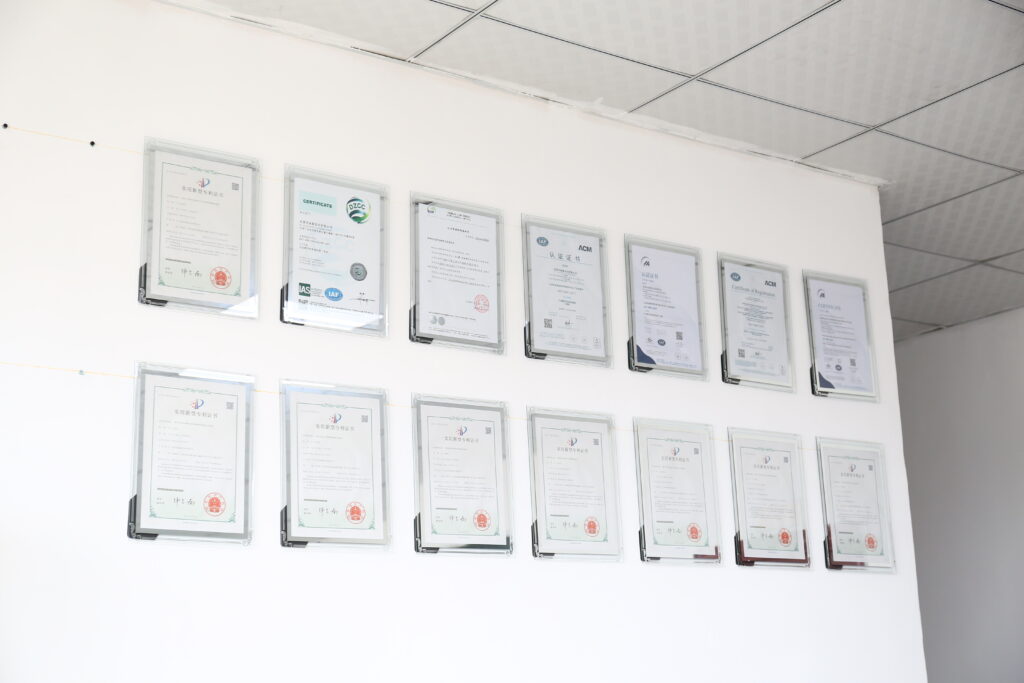
Since its establishment, Yongxin has passed ISO9001 Quality Management System Certification, ISO14001 Environmental Management System Certification, and IATF16949 Automotive Quality Management System Certification, and holds multiple national utility model patents. For automotive buyers, IATF16949 is particularly relevant because it documents the quality system behind coating consistency. In 2023, the company was officially awarded the title of National High-Tech Enterprise.
Comparison: Electrophoretic Coating vs. Powder Coating
Finished parts: powder coating versus electrophoretic coating film results
The core process difference is that e-coating uses a wet immersion process with electrical deposition, while powder coating is a dry electrostatic spray process limited by the Faraday cage effect. E-coating achieves 95%–98% paint utilization, while powder coating achieves approximately 90%. The table below summarizes the factors that matter at the decision stage.
| Comparison Factor | Electrophoretic Coating (E-coating) | Powder Coating |
| Process | Wet immersion in a water-based paint bath; charged paint particles deposit uniformly under a direct current electric field; high-temperature curing forms a continuous film. | Dry electrostatic spray; charged powder adheres to a grounded workpiece; heat melts and fuses the powder into a durable film. |
| Coverage of complex geometry | Superior penetration and edge coverage—coats deep holes, internal cavities, and sharp edges through immersion and electrical deposition. | Limited by the Faraday cage effect; powder can be repelled from deep recesses, leaving internal and corner coverage weaker. |
| Paint utilization | 95%–98% | Approximately 90% |
| Curing temperature | Approximately 100–180°C | Approximately 150–200°C |
| Initial equipment investment | Higher—requires E-coat tanks, ultrafiltration systems, multi-stage rinsing, and pure water machines. | Lower—spray guns, booths, and curing ovens. |
| Operating and maintenance model | Capital-intensive continuous production; strict daily monitoring of bath parameters (pH, conductivity, solids, temperature) and 24/7 circulation. | Flexible discrete production; easy start-stop, simpler color-change maintenance. |
| Best fit | Strict dimensional tolerances, complex geometries, and demanding base anti-corrosion requirements—e.g., automotive frames and chassis, electric motor housings, precision hardware, hydraulic valve blocks, fasteners. | Outdoor aesthetic finishes, sun/rain exposure, and mechanical resistance—e.g., aluminum doors and windows, electrical cabinets, outdoor guardrails, appliance exteriors, metal furniture. |
Decision implication: if the part must pass high salt spray hours and has internal geometry, e-coating’s penetration and edge coverage are the deciding advantages. Powder coating remains a strong option for flat, aesthetic, or UV-exposed exterior surfaces where spray coverage is sufficient.
Conclusion
High salt spray resistance is the result of resin chemistry, process control, pretreatment, and verification. At the decision stage, the checklist is: specify cathodic epoxy e-coating with complete phosphating pretreatment, confirm the line covers your part’s internal geometry, and require salt spray evidence from the manufacturer’s own laboratory.
Dongguan Yongxin Industrial Co., LTD meets these criteria with 6 professional electrophoresis production lines, ISO9001/ISO14001/IATF16949 certified management systems, more than 20 high-precision testing instruments, and a 10,000 m² factory completed in 2025. The next step from comparison to validation is a sample run on your own parts.